.webp)
Blog
Quality Right Of Way Vegetation Management
March 11, 2026
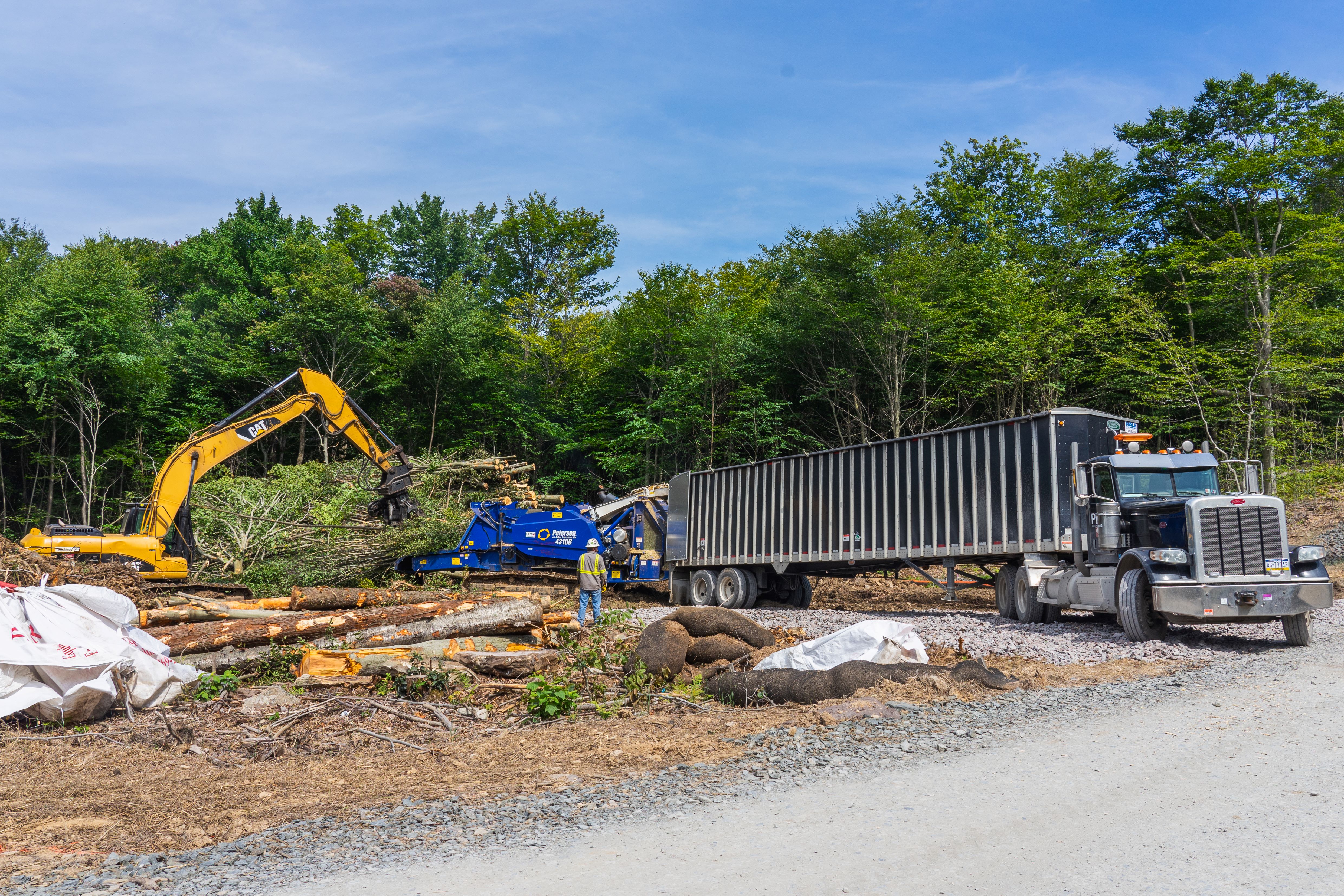
Right of way vegetation management keeps utility, pipeline, and transportation corridors safe and reliable by clearing hazards, controlling regrowth, and meeting regulatory standards. Penn Line delivers an integrated, safety-first program—clearing, line clearance trimming, mowing/mulching, targeted herbicides, erosion control, and emergency response—coordinated with electrical, and civil scopes across OH, WV, VA, PA, and MD. Talk to a Penn Line specialist to build a compliant, budget-controlled ROW strategy.
Key Takeaways
- Adopt an integrated vegetation management (IVM) plan to cut outage risk, wildfire exposure, and lifecycle O&M costs—blend strategic cycles with event-driven work and document everything for audit-ready compliance.
- Targeted herbicide application, used within environmental restrictions, lowers ROW maintenance costs and impact long-term; pair it with selective mowing and compatible revegetation to stabilize corridors and reduce regrowth.
- Prioritize safety and reliability with ISA Certified Arborists, clear 14-foot access roads, and meet Minimum Vegetation Clearance Distance standards (FAC-003-4, GO 95 Rule 35, PRC 4293) to protect energized lines and uptime.
- Match clearing methods to terrain—mechanical mowing, forestry mulching, and grapple/skidder-supported removals—using specialty equipment to manage debris, control erosion, and keep ROW access operational.
Quality Right of Way Vegetation Management
Need right of way vegetation management that keeps your corridors clear, compliant, and under budget without drama?
We deliver exactly that, with a plan that locks in uptime, reduces risk, and gives you clean, audit-ready records every time.
You get predictable costs, safer crews, and fewer emergencies—because prevention beats outage reports and regulatory findings.
Rights-of-way are easements on private land that allow utilities and municipalities reliable access to critical infrastructure across varied terrain, soil, climate, vegetation types, and land use.
In these corridors, vegetation management supports continuity of electricity operations, improves visibility on transportation routes, reduces fire hazards, and protects public safety.
We align our program to your priorities—uptime, cost control, and documentation—through an integrated, safety-first approach across Vegetation & ROW, Electrical & Power, and Civil scopes.
That means strategy, field execution, and records that stand up to scrutiny in Ohio, West Virginia, Virginia, Pennsylvania, and Maryland.
When storms hit, we also mobilize for emergency restoration beyond these regions.
Talk to a Penn Line specialist about your right of way vegetation management goals and lock in reliable performance today.
Vegetation Management Definition: What It Means for Your Project
Our right of way vegetation management approach delivers a precise, field-proven framework for electrical transmission and distribution, pipeline corridors, and transportation routes across Ohio, West Virginia, Virginia, Pennsylvania, and Maryland.
Here’s the vegetation management definition that drives outcomes: it is the integrated control, guidance, and renewal of plant communities within corridors to protect assets, people, and uptime while optimizing lifecycle operations and maintenance.
On your lines, roads, and pipelines, that means establishing compatible, low-growing species, eliminating hazard trees, and maintaining clear access without inflating future costs.
Risk reduction is direct and measurable.
Integrated control reduces outage probability, limits wildfire pathways by favoring less fire-prone vegetation, and reduces liability tied to encroachment, visibility, and worker access.
Your budget benefits as cyclical, planned controls extend maintenance intervals, cutting rework and emergency spend.
Strategic, integrated programs are our default: cyclical inspections, selective removals, mechanical and chemical controls, and adaptive improvements grounded in Integrated Vegetation Management.
We focus on electrical transmission and distribution corridors.
Reactive work remains essential after storms or abnormal events; we restore safe conditions, then return you to the strategic cycle.
Contact us for a custom right of way vegetation strategy built for certainty.
Right of Way Clearing & Maintenance
Right of way vegetation management definition begins with precise clearing, selective removal, and disciplined maintenance cycles that keep your corridors safe, reliable, and audit-ready.
We open and stabilize access for utilities, pipelines, and transportation by targeting incompatible species while preserving compatible, low-growing cover that reduces future work.
Our ISA Certified Arborists lead safety-first execution, combining field-proven judgment with specialized equipment—Jarraffs, feller-bunchers, backyard lifts, bucket trucks, off-road units—to move fast without compromising quality or compliance.
Access roads along rights-of-way, including existing access to structures, are cleared of woody vegetation to widths specified by your standards and herbicide treated where appropriate and requested to maintain operational accessibility.
We then align a maintenance cycle with your outage windows and budget forecasts, integrating the vegetation management definition through mechanical methods and selective chemical control for durable results.
You get clean spans, clear pads, and reliable ingress/egress, season after season.
We mobilize across Ohio, West Virginia, Virginia, Pennsylvania, and Maryland, with dedicated crews ready for rapid deployment.
For critical events, we travel outside these regions for emergency storm restoration.
Schedule a ROW assessment and we will deliver a decisive plan that eliminates bottlenecks and cuts risk.
Line Clearance Tree Trimming for Reliability and Safety
You run mission-critical corridors; we keep them clear, compliant, and online.
Our line clearance tree trimming delivers precise, standards-driven work around energized conductors, substations, and pole lines to protect uptime and public safety.
We implement a documented approach that meets Minimum Vegetation Clearance Distance requirements, recognizing that requirements vary by jurisdiction and asset class, and utilities often add internal clearances.
We match those internal thresholds to your asset ratings and local conditions without compromise.
Our ISA Certified Arborists execute directional pruning that preserves tree vigor while strengthening grid reliability.
Natural target pruning, proper branch collar protection, and growth pattern forecasting reduce regrowth pressure and can extend maintenance cycles.
We coordinate trimming with substation switching windows and pole line construction to minimize outages, align crews, and accelerate closeout.
When spans, terrain, or access complicate the plan, our specialty fleet reaches safely and efficiently.
The result is documented, audit-ready work that helps prevent flashovers, outages, and wildfire ignition sources.
Partner with Penn Line for right of way vegetation management that delivers measurable reliability.
Book line clearance trimming today.
We service Ohio, West Virginia, Virginia, Pennsylvania, and Maryland, with emergency storm restoration beyond, aligning with our vegetation management definition.
Brush Mowing, Forestry Mulching, and Vegetation Removal
Our brush mowing and forestry mulching programs deliver precise, scalable control for dense corridors without compromising access or environmental goals.
This is true right of way vegetation management done properly—mechanical, efficient, and tailored to your terrain.
We deploy Jarraffs, feller-bunchers, backyard lifts, and off-road units to match slope, soils, and clearances, then integrate grapple skidders for safe removals where heavy biomass demands swift extraction.
Selective mowing in rights-of-way is focused on wire zones, access roads, and around structures, retaining large patches of low-growing desirable vegetation where practical to limit disturbance and support habitat resilience.
Forestry mulching processes woody material in place, reducing trucking and erosion risk while creating a stable mulch layer that slows regrowth and protects the soil profile.
During routine operations, we utilize right of way vegetation management to sort debris, disperse chips, and finalize cleanup ensuring clear access and stabilizing drainage to minimize erosion.
If access is constrained, we phase work to maintain uptime and inspection windows.
From Ohio and West Virginia to Virginia, Pennsylvania, and Maryland, we mobilize quickly.
Request a mowing/mulching plan today to lock in predictable results from right of way vegetation management and a clear, documented scope aligned with your standards.
Targeted Herbicide Application and Secondary ROW Treatments
Targeted herbicide application is the backbone of cost-stable, audit-ready right of way vegetation management.
We use selective chemistry and calibrated methods to suppress incompatible species while promoting stable, low-growing plant communities that keep your corridors safe, accessible, and compliant.
The result is fewer outages, cleaner edges, and predictable O&M budgets across Ohio, West Virginia, Virginia, Pennsylvania, and Maryland through efficient vegetation management definition.
We integrate herbicides with secondary ROW services—clearing, mowing, and follow-up treatment—to lock in control cycles and extend maintenance intervals.
This strategic pairing outperforms purely mechanical approaches.
Herbicides have been shown to reduce both the cost and environmental impact of vegetation management across rights-of-way when used appropriately; without herbicides, overall program costs can increase significantly.
We support that efficiency with clear records, product labels, and site-specific plans.
We implement strict setbacks and sensitive-area protocols that comply with applicable regulations and product labels.
Herbicide applications follow label directions and regulatory requirements for buffers near private wells, wetlands, standing water, rivers, streams, and other water bodies.
Talk with us about a custom, compliant plan and get a precise herbicide strategy today.
Erosion Control, Site Revegetation, and Reforestation
We lock in soil stability and compliance from day one, pairing hydroseeding and hydro-mulch with purpose-built erosion and sediment controls—silt sock, matting, water bars, diversion ponds, and stone entrances—across rugged rights-of-way.
Our right-of-way vegetation management team designs controls that perform during real storms, not just inspections, so you keep access open and regulators satisfied.
We then accelerate site revegetation with compatible, low-growing communities that suppress regrowth pressure and cut future maintenance cycles, while targeted reforestation restores canopy where appropriate without threatening conductors or corridors.
You get documentation and schedules that align with civil and electrical milestones, integrating a clear vegetation management definition to help avoid delays, change orders, and fines.
In Ohio, West Virginia, Virginia, Pennsylvania, and Maryland, we synchronize crews and materials to hit narrow in-service windows and protect budgets.
Choose a single partner that delivers erosion control, revegetation, and reforestation as one integrated package focused on reliability, safety, and lifecycle cost control.
Plan your erosion and revegetation scope with Penn Line today.
Storm and Emergency Response for Utilities and Infrastructure
When storms hit, we mobilize fast to restore power and reopen corridors with zero guesswork.
Our right of way vegetation management crews deploy simultaneously across Ohio, West Virginia, Virginia, Pennsylvania, and Maryland with off-road units and bucket trucks to clear hazards, reestablish access, and support de-energized or utility-directed restoration work.
We handle hazardous tree removal and debris clearance immediately, because unstable trees positioned to fall on powerlines, roads, or utility infrastructure can cause outages and accidents.
You get a coordinated field-command structure that syncs with your control center, incorporates vegetation management definition, follows utility switching procedures, and documents every action for audit-ready records.
We travel outside core regions for emergency storm restoration—contact us for rapid mobilization.
Our integrated capabilities tie clearance, access repair, erosion controls, and electrical support into one package, reducing downtime and contractor sprawl.
You gain clear risk triage, safe work windows, and restored accessibility to every structure.
Join our emergency response list to request priority dispatch and resource allocation aligned with your uptime commitments and compliance requirements.
Traffic, Guardrail, and Safety Systems Along ROW
Your corridors demand zero-compromise protection, and we deliver it with integrated traffic control and perimeter systems that help keep people, assets, and schedules safe.
Along transmission, distribution, pipeline, and transport routes, we implement strategies to ensure effective vegetation management definition and maintain guardrails, barriers, security fencing, and perimeter protection to harden access points and reduce unauthorized entry.
We add highway and work-zone solutions—impact attenuators and crash cushions—to help protect crews and the public during live operations and outages.
Our deployments align with your outage windows and construction milestones, pairing engineered barrier layouts with access planning so equipment moves freely while exposures drop.
When visibility is critical at night or in severe weather, we integrate high-contrast delineation to guide traffic and maintain operational safety without slowing production.
This safety-first approach complements your broader right of way vegetation management strategy, supporting reliability gains from vegetation controls.
Talk with us today and secure your ROW with proven, auditable safety systems.
Electrical & Power Integration in ROW
We integrate electrical expertise directly into your corridor, delivering commercial and industrial electrical, mission-critical systems, substation construction, and pole line work without disrupting uptime.
Our crews build and maintain overhead and underground wood and steel pole lines, execute system rebuilds and expansions, and align clearances with protection schemes to safeguard reliability.
Accurate assessment of transmission line behavior under load and weather is essential; we perform professional evaluations that keep your right of way vegetation management program compliant and your grid resilient.
When vegetation intersects energized assets, we coordinate switching, grounding, and access to keep your schedule intact.
We handle fault-tolerant power, grounding for pipeline infrastructure, and power and control wiring at compressor and metering stations, tying vegetation control to asset performance.
You get audit-ready records, from span-by-span clearance verification to as-built updates.
We service Ohio, West Virginia, Virginia, Pennsylvania, and Maryland, and handle vegetation management definition for emergency restoration.
Coordinate an integrated ROW plus electrical scope and eliminate handoffs.
Our team delivers.
Safety, Certifications, and Specialized Equipment
Your corridors demand a proven partner.
Our teams include ISA Certified Arborists and ISA Certified Master Arborists, supported by Lineman Certified and Certified Journeyman professionals who understand energized systems and complex access.
That depth of training powers our right of way vegetation management with precision, speed, and safety.
We deploy a specialty fleet built for varied terrain: Jarraffs for height and reach, feller-bunchers for controlled felling, backyard lifts and remote-control units for tight or unstable ground, grapple skidders and stump grinders for efficient removals, plus forestry mulchers, excavators, bucket trucks, and off-road units to help keep your schedule on track.
We maintain audit-ready documentation, from job hazard analyses to environmental records, satisfying procurement requirements without rework.
Effective transmission programs rely on consistent vendor oversight, rigorous training, and advanced tools for inspection and monitoring—exactly how we execute.
Request a capabilities briefing and secure compliance, performance, and control for your next scope.
Service Areas and How to Start Your ROW Project
You need a partner who moves fast, documents everything, and delivers.
We service Ohio, West Virginia, Virginia, Pennsylvania, and Maryland with the same proven process that keeps your corridors audit-ready and on schedule.
For emergency storm restoration, we mobilize outside these regions—contact us to get on the priority list.
Here’s how we start your project without delay.
First, a focused scope review aligns expectations, constraints, and risk hot spots tied to your right-of-way vegetation management needs.
Next, we perform a joint site walkdown to validate access, terrain, and permitting realities.
Then we align an integrated schedule that sequences clearing, trimming, herbicide controls, and erosion measures as part of our vegetation management definition to support uptime.
Finally, we issue a mobilization plan with safety, quality, and communications defined—then we execute.
Talk with Penn Line today.
Clarify your vegetation management scope, secure budgets, and move dirt with confidence.
Frequently Asked Questions
Right of way vegetation management targets utility, pipeline, and transportation corridors to protect reliability, safety, and compliance, unlike landscaping, which focuses on aesthetics. We manage clearances, access, wildfire risk, and documentation across diverse terrains.
We use targeted herbicides to suppress incompatible regrowth and promote compatible plant communities, extending cycles and lowering O&M costs. Applications follow strict buffers in sensitive areas and align with inspections, mowing, and trimming.
We deploy excavators, skid steers, grapple loaders, whole tree mulchers, stump grinders, feller bunchers, backyard lifts, remote-control units, off-road bucket trucks, and Jarraffs to improve productivity and safety on slopes and tight ROWs.
We plan around outage windows, maintain required clearances, and synchronize with pole line and substation work to help prevent downtime.
We install silt sock, matting, stone entrances, water bars, and diversion ponds, then hydroseed for stabilization across Ohio, West Virginia, Virginia, Pennsylvania, and Maryland. Tell us about your corridor, timeline, and constraints—what’s your biggest ROW challenge right now?